Human-Centric Lighting: How Circadian Lighting Improves Sleep, Health, and Productivity
Hamptons Lighting Design
Human-Centric
Lighting
How circadian lighting supports sleep, health, and productivity through daylight-aligned indoor illumination designed for the way people actually live.
What Is Human-Centric Lighting?
Lighting designed
for people.
Human-centric lighting design aligns indoor light with the body’s natural circadian rhythm.
Instead of providing the same light all day, the system adjusts color temperature and intensity to follow the natural progression of daylight—brighter and cooler in the morning, softer and warmer in the evening.
At its core, this is daylight-aligned indoor lighting. It’s not just about visibility—it’s about how light supports the way people feel, focus, and rest.
Traditional Lighting
Designed primarily for function.
Human-Centric Lighting
Designed to help the body recognize when to be alert and when to rest.

Why Circadian Rhythm Matters
Light is the body’s
timing signal.
Your circadian rhythm is a 24-hour internal cycle that regulates sleep and wake patterns, hormone release, energy levels, mood, and cognitive performance.
When lighting supports that rhythm, sleep improves, focus sharpens, and energy feels more consistent. When it works against it, fatigue and sleep disruption often follow.
Sleep, Health, and Productivity
Recreating the pattern of
natural daylight indoors.
Morning light naturally contains more blue wavelengths. As daylight fades, it becomes warmer and dimmer. Human-centric lighting design recreates this progression indoors using tunable white lighting—especially in spaces with limited daylight.
Morning
Cooler, brighter light suppresses melatonin, increases alertness, and signals the body that it is daytime.
Midday
Neutral, balanced light supports activity, concentration, comfort, and visual clarity throughout the day.
Evening
Warmer, lower-intensity light supports relaxation and helps the body wind down at the right time.
Why Modern Lighting Falls Short
Most lighting is still
static.
Most interior lighting does not change throughout the day. At the same time, people spend most hours indoors, receive insufficient bright daylight, and experience excessive blue-rich light at night from LEDs and screens.
Common Result
Delayed sleep
Common Result
Reduced sleep quality
Common Result
Afternoon fatigue
Common Result
Mood fluctuations
Common Result
Lower productivity
Daylight-aligned indoor lighting addresses this by reintroducing a structured, natural light cycle.
How Human-Centric Lighting Works
Three variables shape the experience.
Modern systems use tunable white lighting to adjust color temperature, intensity, and spectral balance automatically throughout the day.
Color Temperature
- Cooler light (5000–6500K) in the morning supports alertness
- Neutral light (around 4000K) for midday activity
- Warmer light (2700–3000K) in the evening supports relaxation
Intensity
Brighter light during the day strengthens circadian signaling. Lower levels in the evening reduce disruption and support rest.
Spectral Balance
Advanced systems fine-tune the light spectrum to support biological response—stimulating during the day and more restrained at night.
In well-designed spaces, these shifts happen automatically and align with how the space is used.
Benefits Across Environments
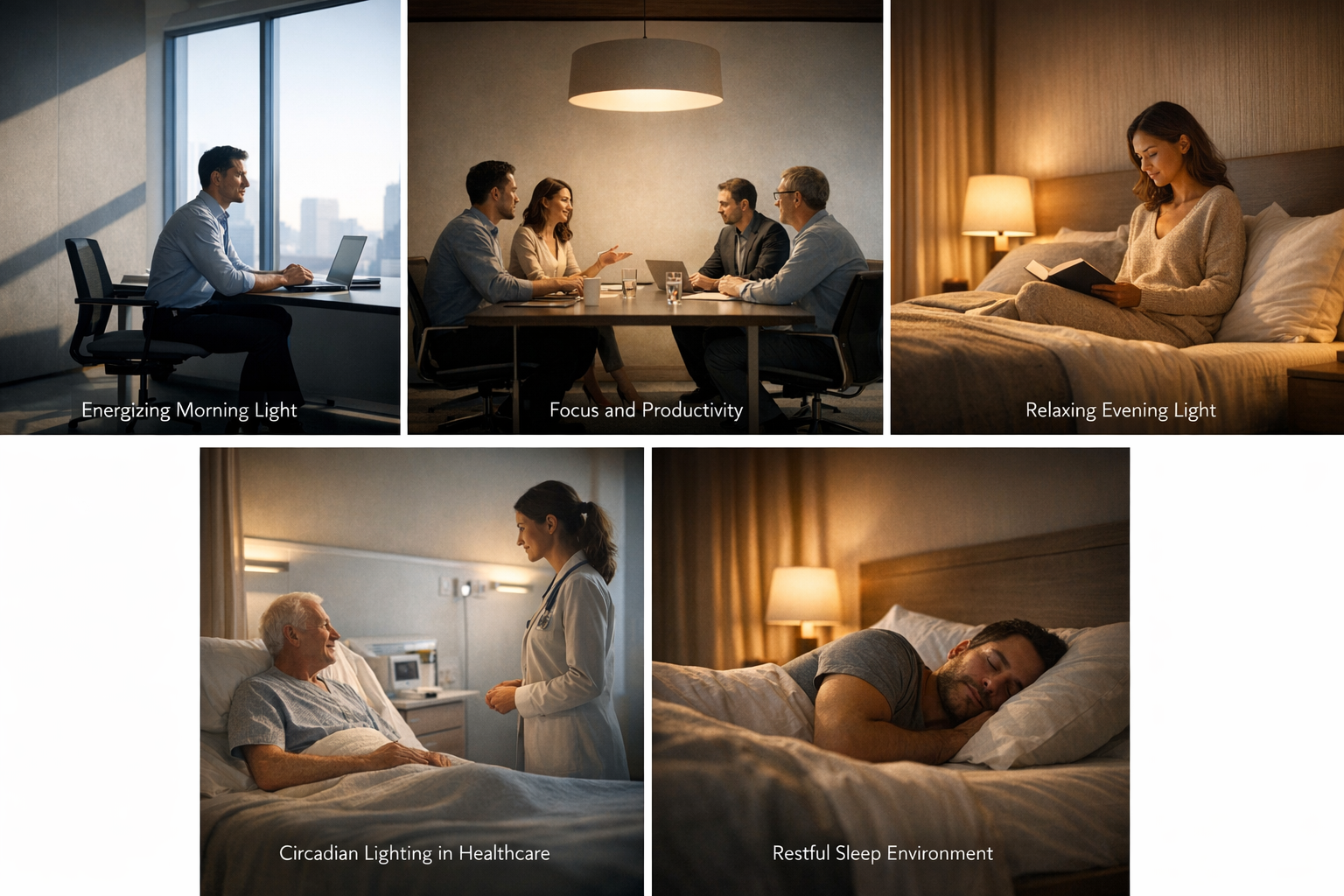
Valuable wherever natural daylight is limited.
Human-centric lighting becomes especially meaningful in spaces that need to support comfort, clarity, routine, and restorative rest.
Workplaces
Supports sustained focus and reduces afternoon energy drops.
Healthcare and Senior Living
Helps stabilize sleep cycles and improve comfort where daylight is limited.
Education
Supports concentration and engagement throughout the day.
Residential Settings
Creates a more natural daily rhythm—supporting both morning wakefulness and evening wind-down.
Human-Centric vs. Traditional Lighting
The difference is not brightness.
It is timing.
Traditional Lighting
Static and task-focused.
Human-Centric Lighting Design
Dynamic and biologically informed.
Is It Worth It?
Particularly valuable in:
When thoughtfully implemented, it becomes a quiet but meaningful contributor to daily well-being.
A Practical Approach to Implementation
Effective systems should feel
natural.
The result should feel natural—not noticeable.
The Direction of Modern Lighting
Lighting is evolving beyond illumination.
It is becoming a tool that supports biology, mood, and performance—especially where natural daylight is limited. When executed well, human-centric lighting design doesn’t feel technical. It simply feels right.
Key Takeaway
Human-centric lighting aligns indoor environments with the rhythm of daylight.
It helps your body understand what time it is—even when you’re indoors.
Frequently Asked Questions
Answers to the most common questions.
What is tunable white lighting?
Tunable white lighting allows the color temperature of light to shift throughout the day—from cooler tones in the morning to warmer tones in the evening—supporting a more natural daily rhythm.
Is human-centric lighting the same as circadian lighting?
They are closely related. Circadian lighting focuses specifically on supporting the body’s internal clock, while human-centric lighting design takes a broader view, including comfort, mood, and overall experience.
Does this replace natural daylight?
No. Natural daylight is always preferred. Daylight-aligned indoor lighting is designed to supplement it—especially in spaces where daylight is limited or inconsistent.
Can this improve sleep?
When properly designed, it can support healthier sleep patterns by reducing late-night stimulation and reinforcing a consistent daily rhythm.
Is this only for commercial spaces?
No. While common in offices and healthcare, it is increasingly valuable in homes—particularly in bedrooms, kitchens, and home offices.
Is the system complicated to use?
Not for the user. Well-designed systems are automated and aligned with daily routines, requiring little to no manual adjustment.